Emergency Tooth Extraction vs. Root Canal in Orem, Utah — How Does Your Dentist Decide?
A throbbing toothache woke you up at 3 a.m. You’ve been managing it for a few days, hoping it would go away — but it hasn’t. Now you’re sitting in the dentist’s chair, and the words you’re dreading most might be coming: 201CThis tooth needs to be addressed right away.201D
What happens next? Will you leave the office with your tooth intact, or without it? For patients across Orem, Utah, this is one of the most emotionally charged moments in dental care — and one of the most misunderstood. The decision between a root canal vs tooth extraction in Orem, Utah is rarely simple, and it’s never made randomly. Your dentist follows a very specific clinical logic, and understanding that logic can help you walk into your emergency appointment informed, calm, and ready to make the best decision for your long-term oral health.
Why the Save-or-Pull Decision Matters So Much
Losing a tooth is not just a cosmetic issue. Every tooth in your mouth plays a structural role — it supports neighboring teeth, maintains your bite alignment, and preserves the bone density in your jaw. When a tooth is extracted without being replaced, the surrounding bone begins to resorb (break down) within months. Teeth on either side can start to drift, leading to bite problems, jaw pain, and even more complex dental work down the road.
That’s why emergency dentists in Orem — and throughout Utah County — are trained to prioritize tooth preservation whenever it’s clinically possible. The root canal vs tooth extraction question isn’t just about the immediate pain. It’s about your dental health for years to come.
What Your Emergency Dentist Evaluates First
When you come in for an emergency dental visit at Canyon Gate Dental in Orem, UT, the evaluation process starts before treatment begins. Your dentist will typically review several key factors:
1. The Extent of Infection or Decay
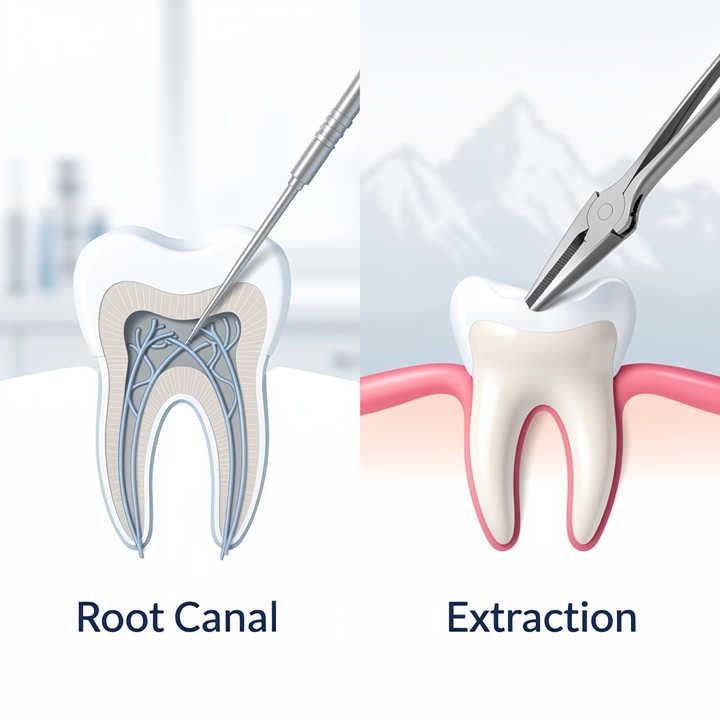
If a tooth has deep decay that has reached the pulp (the inner nerve tissue), a root canal is often the first-line treatment. The procedure removes the infected pulp, cleans the root canals, and seals the tooth — preserving the outer structure so you keep the tooth. However, if the infection has spread significantly beyond the root tips into the surrounding jawbone, saving the tooth may no longer be feasible.
2. The Amount of Remaining Tooth Structure
A root canal requires enough healthy tooth structure to place a crown afterward. If the tooth is fractured below the gumline or has been so severely broken or decayed that there’s insufficient material for a crown to attach to, extraction becomes the more practical option. In these cases, your Orem dentist may recommend an implant or bridge to restore function.
3. The Position of the Tooth
Tooth location matters. Front teeth (incisors and canines) are often worth saving because they’re highly visible and critical for biting. Back molars — especially wisdom teeth — may be extracted more readily, particularly if they’re impacted or have limited biting function. The calculus of saving a tooth shifts depending on where it sits in your mouth.
4. Your Overall Health and Treatment History
Patients with certain medical conditions — such as compromised immune systems or heart conditions — may face different risk profiles for dental procedures. Your dentist will factor in your full health history when recommending an emergency tooth extraction in Orem, Utah or a root canal. Age, bone density, and previous dental work on the affected tooth all play a role in the final decision.
Root Canal vs. Tooth Extraction: The Clinical Breakdown
Here’s a side-by-side look at how these two treatments compare in real emergency scenarios for patients seeking help in Orem and surrounding areas like Provo, Pleasant Grove, and Spanish Fork:
Root Canal — Best When:
- The pulp is infected but the roots and surrounding bone are healthy
- Enough tooth structure remains to support a crown
- The tooth is a front tooth or critical bite tooth
- The patient wants to avoid tooth loss and the costs of replacement
- Infection is localized and responsive to treatment
Tooth Extraction — Best When:
- The tooth is cracked below the gumline or structurally unsalvageable
- Infection has spread deeply into the bone
- Multiple prior root canals have failed on the same tooth
- The tooth is a problematic wisdom tooth causing crowding or recurrent infection
- Cost or treatment timeline is a significant constraint for the patient
It’s worth noting that neither procedure is inherently better than the other — they serve different situations. Many Orem patients who ask ‘should I get a root canal or extraction?’ are really asking: ‘How do I make the smartest decision for my specific situation?’ The answer always depends on clinical findings, not assumptions.
How Emergency Timing Affects the Decision
One of the most overlooked factors in the save or pull a tooth emergency dentist Orem conversation is timing. The longer an infected tooth goes untreated, the more the infection spreads — and the more treatment options narrow.
A tooth that might have been saved with a root canal two weeks ago can become an extraction case after sustained infection breaks down the surrounding bone. This is why emergency dental care in Orem matters so much. Waiting even a few extra days can shift a tooth from “treatable” to “non-salvageable.”
If you’re experiencing severe tooth pain, facial swelling, a dental abscess, or a cracked or broken tooth in Orem or anywhere in Utah County, don’t wait. Getting seen quickly dramatically improves your odds of saving the tooth.
What Happens After the Decision Is Made
Whether you and your dentist decide on a root canal or an emergency tooth extraction in Orem, Utah, the goal is the same: to eliminate pain, clear the infection, and restore your ability to eat, speak, and smile comfortably.
After a root canal, most patients are fitted with a temporary crown immediately and return for a permanent crown within a few weeks. The tooth remains fully functional.
After an extraction, your dentist will discuss tooth replacement options — typically a dental implant (the gold standard), a fixed bridge, or a partial denture. Acting quickly on replacement is important to prevent bone loss and shifting of adjacent teeth. Many Orem patients who need an emergency extraction choose to begin the implant process shortly after healing.
The Cost Factor: Root Canal vs. Extraction in Orem, UT
Cost is a real concern for patients deciding between a root canal vs tooth extraction in Orem, Utah — especially without dental insurance. Here’s how they generally compare:
- Root canal + crown: Typically ranges from $1,200 to $2,000+ depending on tooth location and crown type
- Simple extraction: Often $150–$300 for a straightforward extraction
- Surgical extraction (impacted or complex): $300–$600+
- Dental implant (to replace extracted tooth): $3,000–$5,000+ in most Utah markets
On the surface, extraction appears cheaper — and it often is in the short term. But when you factor in the cost of tooth replacement, saving the tooth through a root canal frequently costs less over a lifetime. Your Canyon Gate Dental team can walk you through financing options and help you understand what your insurance (if applicable) will cover.

Don’t Wait on a Dental Emergency — Call Canyon Gate Dental Today
Whether you need a root canal, an emergency tooth extraction, or just answers, the team at Canyon Gate Dental in Orem, Utah is here to help. We treat dental emergencies same-day when possible and will give you honest, clear guidance on the best path forward for your tooth — and your budget.
Call Us Now | Serving Orem, Provo, Spanish Fork, Pleasant Grove & Utah County
Frequently Asked Questions
Q: Can I choose between a root canal and extraction, or does my dentist decide?
Both. Your dentist will present the clinical recommendation based on the condition of the tooth, but the final decision is always yours. Your dentist will explain the pros, cons, and long-term implications of each option so you can make an informed choice.
Q: How do I know if my tooth is infected or just sensitive?
Sensitivity to hot or cold that lingers after the source is removed, spontaneous throbbing pain, swelling around the tooth or gum, fever, or a pimple-like bump on the gum are all signs of a possible infection. These symptoms warrant an urgent dental visit — don’t wait to see if they resolve on their own.
Q: Is a root canal more painful than a tooth extraction?
Modern root canals are performed under local anesthetic and are typically no more uncomfortable than a standard filling. Many patients are surprised by how painless the procedure is. Extraction is also performed under anesthetic. Post-procedure soreness varies by person and situation, but both treatments are manageable with over-the-counter pain relief in most cases.
Q: What if I can’t afford a root canal in Orem, UT?
Canyon Gate Dental works with patients to find affordable solutions. We offer flexible payment options and can help you understand what your insurance covers. In some cases, a well-planned extraction and implant pathway may be more financially realistic than a root canal and crown — and our team will be honest with you about both paths.
Q: How fast can I be seen for an emergency tooth in Orem, Utah?
Canyon Gate Dental prioritizes dental emergencies. We work hard to see emergency patients same-day or next-day. If you’re in pain, call us right away — the sooner you’re seen, the more options we have to save your tooth.
Q: Is it bad to leave an extracted tooth unreplaced?
Yes, over time. When a tooth is missing, the jaw bone underneath it begins to resorb and neighboring teeth may drift into the gap, affecting your bite and smile alignment. Tooth replacement — ideally with a dental implant — helps preserve the bone and keeps your surrounding teeth in position.
Q: Does Canyon Gate Dental serve areas near Orem, UT?
Yes. In addition to Orem patients, Canyon Gate Dental serves residents of Provo, Spanish Fork, Pleasant Grove, Lindon, Vineyard, and surrounding Utah County communities. Emergency appointments are available — just give us a call.
Related reading: What You Should Eat Right After Having an Extraction