How to Get Your Kids to Actually Brush Their Teeth
By Dr. Nicolas Young, DMD — Canyon Gate Dental, Orem, Utah
Every pediatric dentistry textbook will tell you the same thing: brush for two minutes, twice a day, every day. The ADA recommends it. Dental schools teach it. And every dentist in Orem, Utah, will tell you the same.
What the textbooks leave out is the part where your five-year-old goes completely limp at the word “bedtime.”
Let me tell you how it goes at my house — because if you’re a parent of small children, you’ll recognize this immediately.
The Bedtime Brushing Battle (A Dentist’s Confession)
I have two kids. When they were small, the nightly brushing routine was less of a hygiene habit and more of a full-contact sport.
“Time to brush teeth!” I’d announce, and my two and five-year-olds would scatter like they’d heard a fire alarm — in opposite directions, which I eventually realized was a coordinated tactical decision. I always went for Allie, the five-year-old, first — she was slower. But by the time I caught her, she’d shifted strategies entirely: she went completely limp—dead weight. I’d carry her to the bathroom like a bag of groceries while she debated the cleanliness of her teeth with all the conviction of a courtroom attorney. Her teeth were fine, she insisted. No sugar bugs. Zero. She could feel it.
After three minutes of negotiation — enough time to have done a thorough job — I’d resort to threats against her My Little Pony collection. Reluctantly, she’d apply toothpaste, place the brush in her mouth, agitate it gently for about seven seconds, and declare herself finished. Then I’d do it properly myself. She’s my daughter, and I love her too much to let the sugar bugs win.
Then came Zachary, the two-year-old. Zach skipped the debate phase entirely. What he lacked in negotiating skills, he more than made up for in raw athleticism and a complete disregard for his own safety. Catching him was a sport. Getting the toothbrush into his mouth was an event. Picture a freshly-caught marlin with the jaw strength of a bulldog, and you’re about halfway there. It used to take me fifteen minutes. After enough practice, I got it down to five — and I use the word “practice” the way a rodeo cowboy uses it.
I tell you all this not to undermine confidence in my parenting — though I freely admit my methods were unconventional — but because I know plenty of the families we see at Canyon Gate Dental are fighting the same battle every night. You are not alone, and the struggle doesn’t mean you’re doing it wrong.
Why Two Minutes Matters More Than You Think
Before the strategies, it helps to understand why the two-minute standard exists — because when it feels like you’re wrestling a small animal for seven seconds, knowing why it matters makes it easier to stay the course.
Tooth decay in children remains one of the most common chronic conditions in the United States, affecting roughly one in four kids between the ages of two and five. The bacteria that cause cavities thrive on sugar and produce acid as a byproduct — and that acid is what breaks down enamel. Two minutes of thorough brushing, twice a day, clears away enough of that bacterial film (called plaque) to meaningfully reduce the risk of cavities between dental visits.
Seven seconds doesn’t cut it. Neither does thirty. The two-minute recommendation isn’t arbitrary — it’s the amount of time needed to cover all surfaces of all teeth with the methodical attention they need.
The good news is that two minutes is very achievable, even with a determined five-year-old. You just need the right tool.
The YouTube Trick That Actually Works
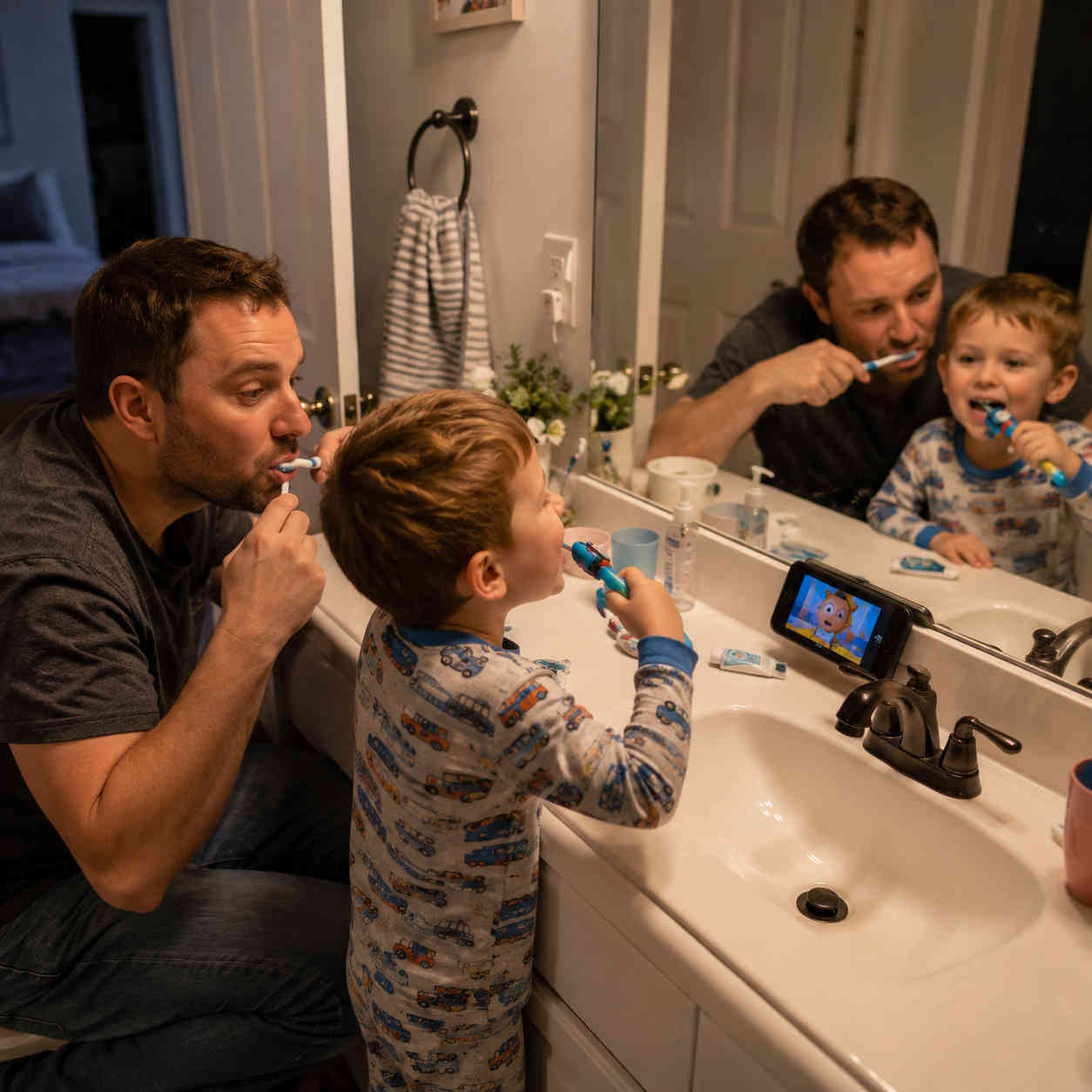
After years of negotiation, threats, bribery, and the occasional miracle, the single most effective thing I found for getting my kids to brush for a full two minutes was a YouTube video playing on my phone, propped up on the sink.
That’s it. No gadget required. No expensive app. Just a two-minute video featuring a character they love, running while they brush.
Something about it changes the whole dynamic. The brushing becomes something that happens during the video — not the thing being argued about. The two minutes passes without incident. And if you pick the right video, it actually models good brushing technique while it plays.
Here are a few that have worked well for families in our practice:
Elmo Brushing Teeth — The gold standard for toddlers. I have personal feelings about Elmo, but I set them aside years ago when I realized he could get my kids brushing longer than any threat I’d ever made. If it works, it works.
Big Block Singsong — Catchy, simple, and exactly two minutes. Works particularly well for kids who respond to music and movement.
Kids TV 123 — Clear, instructional brushing technique shown in a format that holds young attention well.
Search any of these on YouTube, hit play, prop your phone on the counter, and watch your previously combative child suddenly become cooperative. It won’t work every single night — nothing works every single night — but the batting average improves significantly.
More Tips That Actually Help
Beyond the YouTube trick, here are a few other strategies that families in our Orem dental practice have found genuinely useful:
Let them pick their toothbrush. It sounds small, but ownership matters to kids. A toothbrush featuring their favorite character gets used more willingly than one chosen by you. Same goes for toothpaste — kid-friendly flavors (strawberry, bubblegum) dramatically reduce the “I don’t like the taste” objection.
Brush together. Kids model adult behavior more reliably than they follow instructions. If they see you brushing at the same time, it normalizes the routine and turns it from a directive into something the whole family does together.
Use a timer or a song. If YouTube isn’t available, a two-minute timer on your phone or a simple song creates the same effect. The goal is to give the child something to focus on other than how much they’d rather be doing anything else.
Make the stakes clear — but age-appropriately. For older kids, a simple explanation of what cavities actually are — and what the dentist does to fix them — provides concrete motivation. Most kids, when they understand that cavities mean drilling, become markedly more cooperative about prevention.
Start early and be consistent. The sooner oral hygiene becomes a non-negotiable part of the bedtime routine — like pajamas and a story — the less resistance you’ll encounter. Kids who grow up brushing as a natural part of the evening don’t fight it the way kids for whom it feels like an interruption do.
Don’t skip the follow-up brush. For younger kids, especially, let them brush first — it builds independence and habit — and then do a follow-up pass yourself to make sure everything was actually covered. Children generally don’t have the manual dexterity to brush effectively on their own until around age seven or eight.
When to Bring Kids to the Dentist in Orem
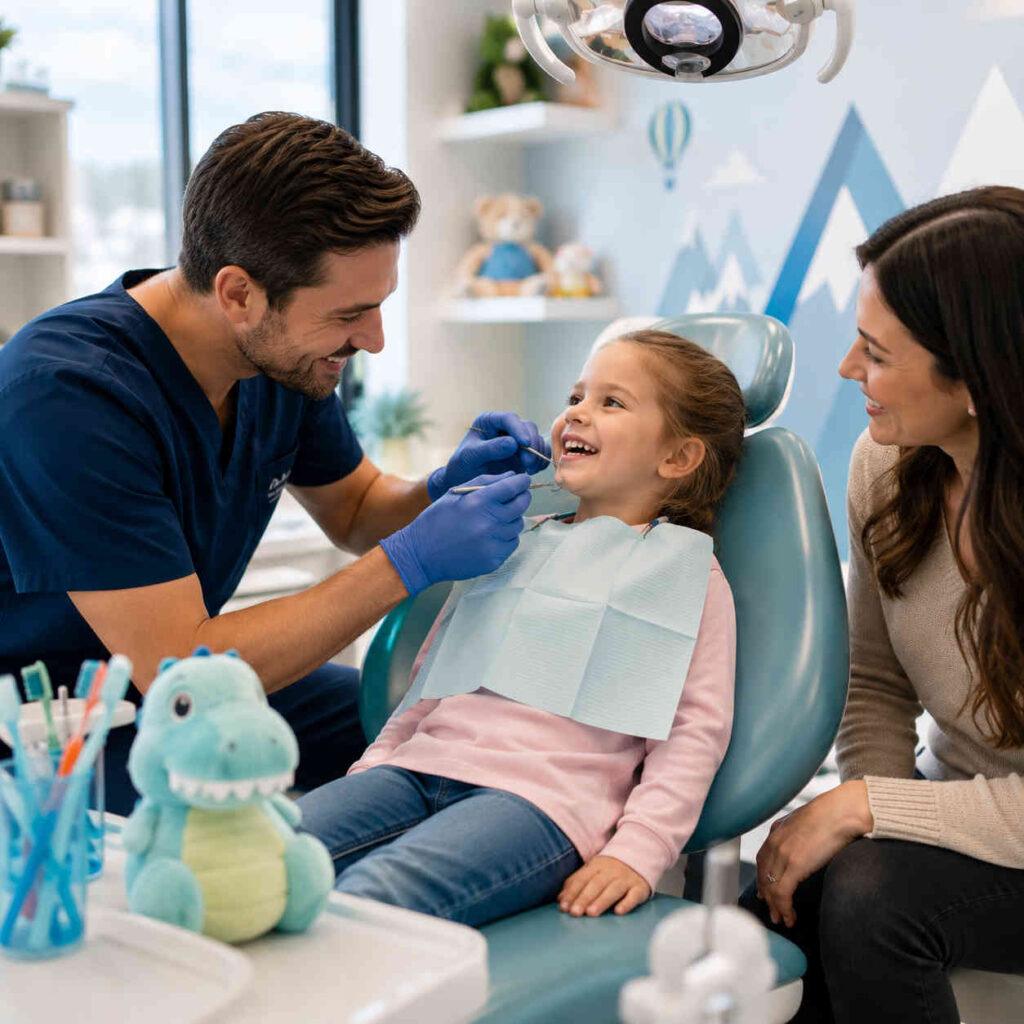
The American Academy of Pediatric Dentistry recommends a child’s first dental visit by age one, or within six months of the first tooth erupting — whichever comes first. This sounds early, but these first visits are short, gentle, and primarily about examining the erupting teeth, checking development, and giving parents guidance on home care. They also introduce your child to the dental environment in a low-stakes way, which pays dividends later when more involved care is needed.
After that first visit, children should see a dentist every six months, just like adults. Regular cleanings catch early decay before it becomes a filling, and our team at Canyon Gate Dental is experienced in making those visits comfortable and even fun for kids who are nervous.
If your child has never been in, or if it’s been longer than six months, give us a call. We see families from throughout Orem and Utah County, and we love working with young patients — even the ones who arrive with strong opinions about whether their teeth need cleaning.
Schedule Your Child’s Next Visit at Canyon Gate Dental in Orem, Utah
Two minutes of brushing tonight. A cleaning every six months. That combination does more for your child’s long-term dental health than almost anything else.
And when the brushing battle gets you down, put Elmo to work. You can thank me later.
Call Canyon Gate Dental in Orem, Utah, at 801-764-9444 to schedule your child’s next dental visit.
We’re located at 440 W 800 N, Orem, UT 84057. We see children of all ages and love helping Orem families build healthy habits that last a lifetime. Book online at canyongatedental.com or call us today.
— Dr. Nicolas Young, DMD
Frequently Asked Questions
Q: When should my child first visit the dentist in Orem, Utah? The American Academy of Pediatric Dentistry recommends a first visit by age one, or within six months of the first tooth coming in. Canyon Gate Dental in Orem sees young patients for gentle, friendly first visits that set the foundation for a lifetime of healthy dental habits.
Q: How long should kids brush their teeth? Two minutes, twice a day — morning and before bed. That’s the ADA recommendation, and it’s backed by solid research on plaque removal and cavity prevention. A two-minute YouTube video is one of the most effective tools for hitting that target with young kids.
Q: My child refuses to brush. What should I do? Try the YouTube approach — a two-minute brushing video playing on your phone while they brush changes the dynamic for many kids. You can also let them pick their own toothbrush and toothpaste flavor, brush at the same time they do, and use a timer. If resistance is extreme or consistent, mention it at your next visit, and we can help with age-appropriate strategies.
Q: Should I brush my toddler’s teeth for them? Yes. Children typically don’t have the dexterity to brush effectively on their own until around age seven. Before that, the recommended approach is to let them brush first to build the habit, then follow up with a proper brush yourself. Canyon Gate Dental’s pediatric team can show you the best technique during your visit.
Q: How often should kids get professional cleanings in Orem, Utah? Every six months, same as adults. Regular cleanings at Canyon Gate Dental catch early decay, monitor tooth development, apply fluoride if appropriate, and keep your child comfortable with the dental environment from an early age.
Q: Is fluoride toothpaste safe for young children? Yes, with age-appropriate amounts. For children under three, use a rice-grain-sized amount of fluoride toothpaste. For ages three to six, a pea-sized amount is appropriate. For children old enough not to swallow toothpaste, standard fluoride toothpaste is recommended. Ask our team at your child’s next visit if you have questions about the right product for your child’s age.
Q: Does Canyon Gate Dental see kids for pediatric dental care in Orem? Yes. We provide pediatric dental care for children of all ages — from first visits through the teenage years. Our team is experienced in working with nervous or reluctant young patients, and we work hard to make every visit as comfortable and positive as possible.