dental bonding vs. Veneers in Orem, Utah — Which One Is Right for Your Smile?
If you’ve been researching cosmetic dentistry options in Orem, Utah, you’ve almost certainly run into both dental bonding and porcelain veneers. Both are popular. Both improve the appearance of teeth dramatically. And for patients trying to decide between them, both can feel like a moving target — similar enough that the distinction isn’t clear, different enough that making the wrong choice means the wrong outcome.
The confusion is understandable. Bonding and veneers address many of the same cosmetic concerns. But they differ significantly in how they work, how long they last, what they cost, and what the treatment experience involves. Making the right choice means understanding those differences clearly — not in dental jargon, but in the practical terms that actually affect your life and your wallet.
This guide from Canyon Gate Dental in Orem, Utah gives you an honest, side-by-side comparison of dental bonding versus porcelain veneers so you can walk into a consultation already knowing what questions to ask and what factors matter most for your situation.
The Core Difference: How Each Treatment Works
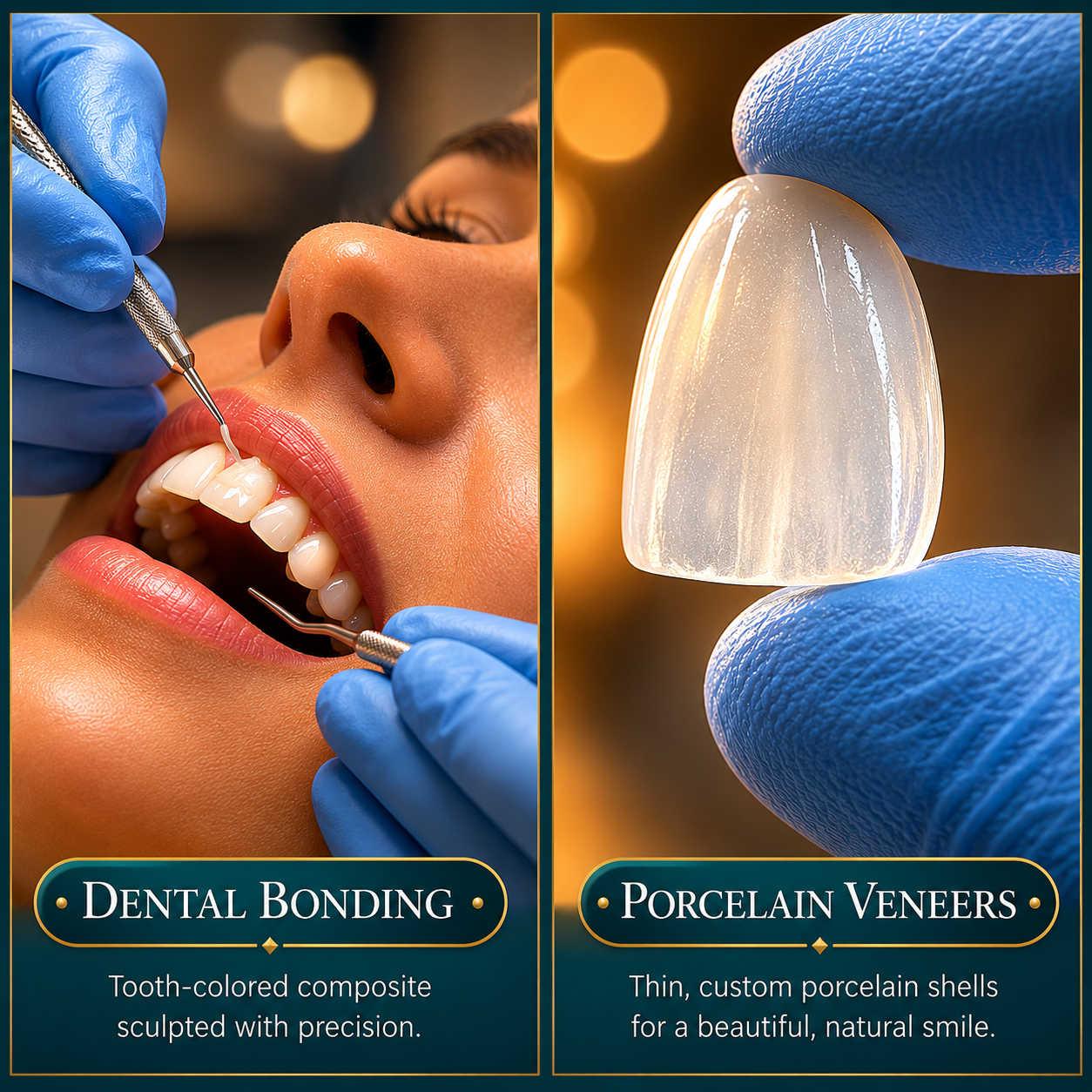
Dental bonding uses tooth-colored composite resin — the same material used in modern tooth-colored fillings — applied directly to the tooth surface. The resin is shaped by the dentist’s hands and instruments, hardened with a curing light, and polished to a smooth finish. Nothing is manufactured in a laboratory. Everything happens chairside, in a single appointment.
Porcelain veneers are thin shells of dental-grade ceramic that are custom-fabricated in a dental laboratory and bonded to the front surface of teeth. Creating them requires removing a thin layer of enamel — typically about half a millimeter — to make room for the veneer shell. Because the veneers are lab-made, the process requires at least two appointments.
That fundamental difference — chairside composite versus laboratory ceramic — drives almost every practical distinction between the two, including cost, longevity, appearance, and the commitment level required.
Appearance: Can You Really Tell the Difference?
Both bonding and veneers are designed to look natural, and both can produce beautiful cosmetic results when done well. But there are meaningful differences in the ceiling of each treatment.
Dental bonding is highly effective for isolated repairs and single-tooth improvements. The limitation of bonding is that composite resin is somewhat more susceptible to staining over time from coffee, tea, and other pigmented foods and drinks.
Porcelain veneers have a significant aesthetic advantage for patients pursuing broader smile makeovers — particularly when multiple front teeth are being addressed at once. Porcelain’s resistance to staining is dramatically better than composite resin, and its optical properties more closely mimic the natural depth and translucency of tooth enamel.
For a single chipped or stained tooth that needs to match neighbors it lives alongside every day, the right bonding job is often visually indistinguishable from a veneer. For a full smile transformation across six to ten front teeth, veneers tend to produce more consistent and dramatic long-term results.
Cost: A Significant and Real Difference
For most patients in Orem, Utah exploring cosmetic dentistry, cost is one of the most important practical considerations — and here the gap between bonding and veneers is substantial.
Dental bonding is one of the most affordable cosmetic dental procedures available. A single bonded tooth at Canyon Gate Dental in Orem, Utah represents a fraction of the cost of a veneer on the same tooth. For patients addressing one or two teeth, the total investment is often manageable without financing.
Porcelain veneers are a more significant financial commitment. Each veneer involves laboratory fabrication costs in addition to the clinical procedure fees. A full set of veneers covering the front teeth is a meaningful investment that most patients plan and save for deliberately.
Longevity: How Long Does Each Last?
Dental bonding typically lasts five to ten years before needing touch-ups or replacement. The composite resin gradually accumulates micro-staining and surface wear over time, and areas of high biting force experience more wear than lower-pressure locations.
Porcelain veneers generally last fifteen to twenty years or longer with proper care. Porcelain is significantly harder and more stain-resistant than composite resin, and laboratory-fabricated ceramic is produced to tighter tolerances than chairside-applied bonding.
There’s an important nuance here: bonding’s shorter lifespan doesn’t necessarily make it the inferior choice. A patient who bonds a single chipped tooth affordably and has it refreshed every seven to ten years may ultimately spend less over a lifetime than a patient who gets veneers — while preserving more natural tooth structure in the process.
Reversibility: A Critical Factor Most People Don’t Consider
Dental bonding is largely reversible. Because the procedure involves minimal or no removal of natural tooth structure, bonding can be removed or replaced without permanent consequences to the underlying tooth.
Porcelain veneers are not reversible. Because preparing a tooth for a veneer requires permanently removing a thin layer of enamel, a tooth that has been prepared for veneers will always need a veneer — enamel doesn’t grow back. This is the right trade-off for patients who are committed to veneers and want the most durable result available, but it means the decision deserves serious consideration before proceeding.
Treatment Experience: What Each Involves on the Day
Dental bonding at Canyon Gate Dental in Orem is completed in a single appointment. In most cases it requires no anesthesia, no temporary restorations, and no laboratory wait. Most appointments take thirty minutes to an hour per tooth.
Porcelain veneers require at minimum two appointments, separated by one to three weeks. At the first appointment, teeth are prepared, digital impressions are taken, and temporary veneers are placed while the permanent veneers are fabricated in a laboratory. At the second appointment, the permanents are bonded in place.
Dental Bonding vs. Veneers: Quick Reference
| Dental Bonding | Porcelain Veneers |
|---|
Which Is Right for You? A Simple Framework
Choose dental bonding when: you need to repair one or two specific teeth, you want the most affordable option, you prefer to preserve as much natural tooth structure as possible, or you need the issue addressed quickly.
Consider porcelain veneers when: you want to transform the appearance of multiple front teeth comprehensively, you prioritize the most stain-resistant and longest-lasting result available, and you’re making a planned investment in your smile rather than addressing an acute problem.
Come in for a consultation at Canyon Gate Dental when: you’re not sure. Our cosmetic dentistry team in Orem, Utah can evaluate your teeth, understand your goals and budget, and give you an honest recommendation — including whether your case is one where bonding will deliver the same result as veneers for a fraction of the cost, or whether veneers are the better long-term investment.
Get the Right Cosmetic Treatment — Call Canyon Gate Dental in Orem, Utah
Whether bonding or veneers is the right answer, the next step is a conversation.
We’ll evaluate your teeth, understand your goals, and give you an honest recommendation.
Call us at 801-764-9444
440 W 800 N, Orem, UT 84057
Frequently Asked Questions
Q: Is dental bonding or veneers better for a single chipped front tooth in Orem, Utah?
For a single chip, dental bonding is almost always the better starting point. It’s faster, less expensive, requires no removal of tooth structure, and can be done in one appointment at Canyon Gate Dental. Veneers are typically more appropriate when multiple teeth are being transformed comprehensively.
Q: How much cheaper is dental bonding compared to veneers in Orem, Utah?
Bonding is significantly more affordable than veneers on a per-tooth basis. The exact difference depends on case complexity. Canyon Gate Dental provides clear cost estimates at consultations — call 801-764-9444 for current pricing.
Q: Can dental bonding look as good as veneers?
For single-tooth repairs and minor corrections, skilled bonding is visually indistinguishable from a veneer in most cases. For broader smile transformations involving multiple front teeth, porcelain veneers tend to deliver more consistent long-term aesthetic results due to superior stain resistance.
Q: Will I need shots for dental bonding at Canyon Gate Dental in Orem?
For most cosmetic bonding cases — chips, gaps, surface stains — no anesthesia is needed. The procedure involves no drilling and most patients find it entirely comfortable.
Q: Do porcelain veneers damage your natural teeth?
Veneer placement requires removing a thin, permanent layer of enamel from the front of each tooth. This is irreversible — teeth prepared for veneers will always require veneers. Canyon Gate Dental discusses this distinction thoroughly at every cosmetic consultation.
Q: Can dental bonding be upgraded to veneers later?
Yes. Many patients in Orem choose dental bonding as a first step and later upgrade to veneers when the timing and budget are right for a more comprehensive smile transformation. Because bonding preserves natural tooth structure, the option to move to veneers later remains fully available.
Q: How do I care for bonded teeth vs. veneered teeth?
Care for both is essentially the same: brush twice daily, floss regularly, and attend routine cleaning appointments at Canyon Gate Dental every six months. For bonded teeth, avoid nail biting, ice chewing, and using teeth to open packaging.