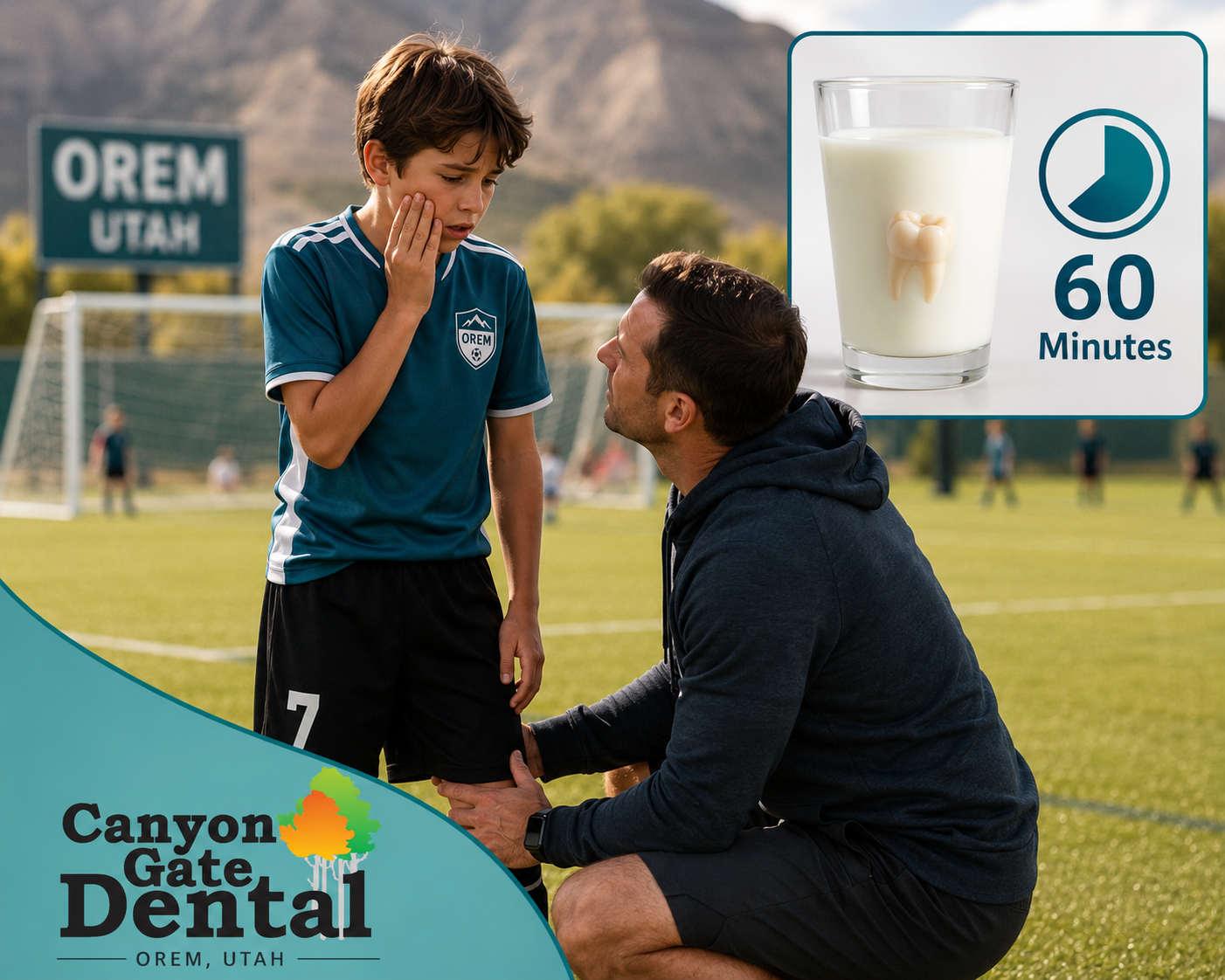
A tooth just came out. Maybe it was a collision at an Orem soccer field, a fall from a bike, an elbow at a basketball game, or a hit nobody saw coming. However it happened, you have a tooth in your hand and approximately 60 minutes to save it.
That’s not an exaggeration, and this isn’t the moment for a slow read. Here’s the short version: pick the tooth up by the crown, store it in whole milk or saliva, and call Canyon Gate Dental at 801-764-9444 right now. The faster you act, the better the chance that tooth goes back in your mouth and stays there.
The longer version — the biology, the step-by-step, the mistakes to avoid, what happens at the dental appointment — is below. Read it, then save this page somewhere you can find it when it matters.
Why 60 Minutes Is the Number That Changes Everything
A knocked-out tooth isn’t just a tooth that fell out. It’s a living structure that has been severed from its blood supply and from the periodontal ligament — the thin layer of connective tissue fibers that attaches the root to the bone socket and cushions the tooth against chewing forces.
Those periodontal ligament cells are still alive on the root surface after the tooth comes out. But they’re not alive indefinitely. They begin dying from desiccation — drying out — and from exposure to unfavorable pH levels within minutes of leaving the socket. The longer the tooth is out, and the worse the storage conditions, the more of those cells die. And once they’re dead, reimplantation becomes progressively less likely to succeed because the biological mechanism that allows the tooth to reattach to the bone is compromised.
Research on avulsed teeth shows the highest reimplantation success rates when the tooth is returned to the socket within 30 minutes. Success rates remain meaningful up to 60 minutes with proper storage. Beyond 60 minutes — particularly in dry storage — the outcome becomes significantly less predictable.
This is why every minute genuinely matters. Not as hyperbole. As biology.
The 60-Minute Action Plan — Step by Step
Use this when it happens. Every step is in the right order for a reason.
| Step | What to Do | What NOT to Do |
| 1. Find the tooth | Locate it immediately — account for it | Don’t leave the scene without it |
| 2. Pick it up | Hold it by the crown — the white part you see when smiling | Never touch the root — the pointed end |
| 3. Check for contamination | If it landed on dirt or grass, it needs a brief rinse | Don’t scrub it, use soap, or wrap it dry |
| 4. Rinse if needed | Cool, clean water — 10 seconds maximum | No scrubbing, no soap, no hydrogen peroxide |
| 5. Reposition if possible | Gently slide it back into the socket — right orientation, all the way in | Don’t force it if there’s resistance |
| 6. Hold it in place | Bite gently on damp gauze or a clean cloth | Don’t chew on it or press too hard |
| 7. If repositioning fails — store it | Whole milk, or tuck it between cheek and gum | NOT plain water, NOT dry cloth, NOT plastic bag dry |
| 8. Call Canyon Gate Dental | 801-764-9444 — tell them a tooth was knocked out | Don’t drive there first without calling |
| 9. Get there | Move immediately — bring the tooth and the storage | Don’t stop for anything that isn’t necessary |
Where to Keep the Tooth on the Way — Storage Ranked Best to Worst
The storage medium you choose for the knocked-out tooth in the time between the injury and your appointment matters more than most people realize. Here’s every option ranked, with the reasoning:
1. Back in the socket — best possible option The socket is the original environment the tooth was designed to sit in. It maintains the right temperature, pH, and moisture for root cell survival. If you can reposition the tooth correctly and keep it there, this is by far the best outcome. It’s only appropriate for adults and older children who will not accidentally swallow the tooth.
2. Whole milk — the gold standard for transport Whole milk works because its osmolality — the concentration of dissolved particles — is compatible with the cells on the root surface, meaning it doesn’t cause them to swell and rupture the way plain water does. Its pH is also appropriate for cell survival. If the tooth can’t go back in the socket, put it in a small cup of whole milk immediately. This is what Canyon Gate Dental will tell you over the phone, and it’s what dental trauma research consistently supports.
3. Saliva — held in the cheek Storing the tooth between the cheek and gum keeps it in a biologically compatible environment. This works for adults and older teens who understand not to swallow it. Have the patient — or you — tuck it into the cheek carefully. Not recommended for young children.
4. Saline solution Contact lens saline is a reasonable option if milk and the socket aren’t available. It’s not as good as milk but significantly better than plain water.
5. Nothing — dry storage If none of the above is available, dry storage is a last resort. It allows root cells to die more quickly, but getting the tooth to the dentist quickly still gives the situation the best possible remaining chance. A dry tooth for 20 minutes is better than no tooth at all.
What ruins a tooth in transport: Plain water is the most common mistake — it sounds logical but is actually harmful. The osmotic pressure difference between plain water and root cells causes the cells to swell and rupture within minutes. No cell survival = no reimplantation success. Similarly, wrapping the tooth in dry gauze or tissue and storing it dry for any significant amount of time rapidly kills root cells. And scrubbing the root surface to clean it removes the very cells that need to be preserved.
Baby Tooth or Permanent Tooth — The Answer Changes Everything
This is the most important distinction in knocked-out tooth management, and it’s one that parents need to know before they’re in the middle of an emergency.
If a permanent tooth was knocked out: Act immediately using the steps above. Call Canyon Gate Dental, store the tooth properly, and get there as fast as possible. Time is the most important variable.
If a baby tooth was knocked out: do not attempt to reimplant it. This is not a cost or complexity issue — it’s a clinical one. Beneath every baby tooth is the developing permanent tooth that will eventually replace it. Pushing a baby tooth back into the socket risks damaging that developing tooth, which can cause significant, permanent harm to the adult tooth that follows. A knocked-out baby tooth is an urgent situation — you should still call Canyon Gate Dental at 801-764-9444 immediately — but the treatment is evaluation, monitoring, and possible space preservation, not reimplantation.
How to tell the difference: Permanent teeth are larger, have a single root, and are whiter with a harder, more defined surface. Baby teeth are smaller, slightly more translucent, and have a noticeably smaller root. If you genuinely can’t tell, call us — we’ll help you figure it out in thirty seconds.
What Happens at Canyon Gate Dental When You Arrive
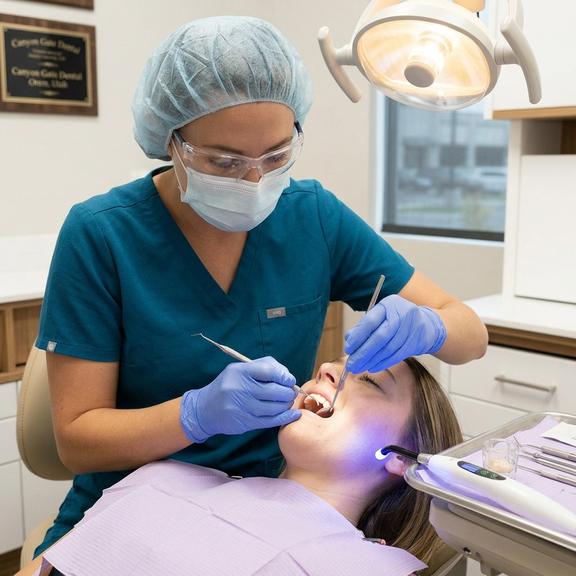
When you call ahead and come straight to Canyon Gate Dental in Orem with a knocked-out permanent tooth, the appointment moves immediately and purposefully.
Digital X-rays are taken right away to evaluate the socket, confirm there’s no fracture of the socket walls or jawbone, and assess the root length and structure of the tooth being reimplanted.
The tooth is prepared for reimplantation — gently evaluated, rinsed with saline if needed, and the socket is carefully cleaned of any clot that may have formed.
Local anesthesia is administered so reimplantation is comfortable. The tooth is then guided carefully back into the socket at the correct depth and orientation.
A flexible dental splint is bonded to the reimplanted tooth and the adjacent teeth on either side, holding the tooth stable while the periodontal ligament begins to reattach to the bone. This splint typically stays in place for one to two weeks.
A follow-up root canal is planned and discussed. In most adult cases, the nerve tissue inside the tooth dies after reimplantation because the blood supply was severed at the time of the injury. A root canal — performed one to two weeks after reimplantation — removes that dying tissue and seals the tooth to prevent internal infection. It’s a standard and expected part of the process, not a complication or a bad sign.
Before you leave, you have a clear aftercare plan: what to eat, how to clean around the splint, what to watch for, and when to come back. The appointment is focused and fast — we know you came in in a state of panic and we work to resolve that as quickly as the clinical situation allows.
Orem’s Sports Culture and Why You Should Have a Plan Before You Need One
Orem runs one of the most active youth and recreational sports communities in Utah County. From Orem City Recreation’s year-round soccer and basketball programs to the fields and courts at Mountain View High School, Orem High School, and dozens of parks throughout the city — dental trauma from sports collisions is a genuine, recurring reality in this community.
The families who handle knocked-out tooth situations best share one thing: they already knew the basics before it happened. They’d seen or read something like this post, they knew milk was better than water, they knew not to scrub the root, and they had Canyon Gate Dental’s number somewhere they could find it in thirty seconds of controlled panic.
The ones who lose the tooth usually made one of three mistakes: they stored it wrong, they waited too long, or they went somewhere that couldn’t perform reimplantation.
Save this number in your phone right now: 801-764-9444.
If your kid plays any contact or collision sport — soccer, basketball, football, baseball, rugby, martial arts, mountain biking — consider talking to Canyon Gate Dental about a custom-fitted sports mouthguard. They’re one of the most effective and underused pieces of protective equipment in youth athletics, and a properly fitted guard dramatically reduces the forces transmitted to the teeth during impact. Prevention is always better than the 60-minute scramble.
Knocked Out a Tooth in Orem, Utah? Call Canyon Gate Dental Right Now
Every minute counts. If you or your child just knocked out a permanent tooth, stop reading and call.
Canyon Gate Dental — 801-764-9444 We make every effort to see knocked-out tooth patients the same day — often immediately. Store the tooth in milk, get in the car, and call us on the way. We are located at 440 W 800 N, Orem, UT 84057, serving families throughout Orem, Provo, Lindon, American Fork, Pleasant Grove, and all of Utah County.
If this is a planning read — save our number, share this post with your coaching staff or school nurse, and consider a consultation about sports mouthguards before the next season starts. The 60-minute rule is something you’d rather know about before you need it.
Frequently Asked Questions
Q: How long do you actually have to save a knocked-out tooth in Orem, Utah? The best outcomes occur when the tooth is reimplanted within 30 minutes. Success rates remain meaningful up to 60 minutes, especially with proper storage in whole milk or saliva. Beyond 60 minutes, the periodontal ligament cells on the root surface have usually died in significant numbers, making successful reattachment less likely — though reimplantation can still be attempted. Every minute matters. Call Canyon Gate Dental at 801-764-9444 immediately.
Q: Can I store a knocked-out tooth in water until I get to the dentist? No — plain water is one of the worst storage options for a knocked-out tooth. The osmotic pressure difference between water and root cells causes the cells to rupture within minutes. Use whole milk, saliva (held between the cheek and gum), or sterile saline instead. If none of those are available, keeping the tooth moist in any liquid is better than dry storage, but milk is always the preferred choice.
Q: Should I try to put the tooth back in myself? Yes, if the patient is an adult or older child who won’t accidentally swallow it, and if you can do so gently without forcing it. Hold the tooth by the crown, rinse it briefly if it’s dirty, and slide it back into the socket in the correct orientation. Bite gently on damp gauze to hold it and call Canyon Gate Dental immediately. The socket is the best possible storage environment for the tooth.
Q: What if my child knocked out a baby tooth — do I still need to go to the dentist? Yes, but baby teeth are NOT reimplanted. Attempting to reposition a knocked-out baby tooth risks damaging the permanent tooth developing underneath it. However, the area still needs to be evaluated by a dentist to confirm no root fragments remain in the socket and that the developing permanent tooth is unaffected. Call Canyon Gate Dental at 801-764-9444 and we’ll advise you on the appropriate next step.
Q: Will my child need a root canal after the tooth is reimplanted? In most cases involving adult patients, yes — a root canal is typically performed one to two weeks after reimplantation. When a permanent tooth is knocked out, the blood supply to the nerve is severed. The nerve tissue dies, and a root canal removes it and seals the tooth to prevent internal infection. This is expected and planned for — it’s not a sign that the reimplantation failed. For younger patients with open root apices, the biology is slightly different and the dentist will advise accordingly at the appointment.
Q: Does Canyon Gate Dental treat sports tooth injuries for kids in Orem? Yes. Canyon Gate Dental provides emergency dental care for both children and adults and handles dental trauma including knocked-out, broken, and cracked teeth resulting from sports injuries, falls, and accidents. We see patients throughout Orem and Utah County and make every effort to provide same-day appointments for tooth trauma emergencies. Call 801-764-9444 as soon as the injury occurs.
Q: Can a mouthguard prevent a knocked-out tooth? Significantly reduce the risk, yes. A properly fitted custom sports mouthguard — fabricated at Canyon Gate Dental based on your child’s actual bite — provides far more protection than stock mouthguards purchased from a sporting goods store. For any athlete in a contact or collision sport, a custom mouthguard is one of the most cost-effective protective measures available. Ask us about mouthguards at your next visit or call 801-764-9444 to schedule a fitting.